7 Reasons to Consider a Home Gym

If you think of picking up better health habits and don't like crowded gyms, consider setting a home gym catered to your needs.

5 Top Picks for Christmas Holiday Like a Fairytale

If you imagine Christmas holiday this year being like a fairytale, you should consider visiting these hidden gems!

7 Fashion Accessories To Lift Up Your Style Quotient

Get heads up on the trendiest as well as classic fashion accessories that would elevate your style to another level.

Sensibo

Showing posts with label Flight. Show all posts

Space Travel and Exploration: Dreaming About the Future of Space Tourism

Description :

Welcome fellow hustler! Busy morning? Here's what you need to know to start your day.

For ages mankind has dreamed of traveling the stars and visiting distant planets. Not just astronauts but civilians too. Over the years we have seen a few of these achievements come to fruition. People have been sent up to orbit the earth and collect data for scientists back on the planet. A select few have claimed the great achievement of setting foot on the moon. A rover was even sent to Mars and transmitted back pictures of the alien surface.

Space Travel and Exploration: Dreaming About the Future of Space Tourism

Even with all these advancements over the last 30 years, space exploration is still in its infancy. The recent crash of Virgin’s Space Ship Two can attest to that. Not only are the ‘kinks’ still being worked out, but what has been explored so far, is merely a drop in the ocean when compared to the billions and billions of stars that have yet to be reached. Aside from Mars and the Moon, our own solar system remains an unexplored mystery. With the future of space tourism hinging on uncertainty; what does this mean for the average citizen?

The taxpayer no longer foots the bill

When the idea of space travel was first put on the table, it was the taxpayer’s dollars that funded the missions. Politicians formed the plan, while the working class paid for it. With the introduction of private spaceflight, the politicians have no say and the American citizen isn’t left paying for everything. The only real restriction they have is how much money is available.

Failure is an option

Private companies can fail as much as they want, within reason. They aren’t tied to an ever shrinking budget like NASA was. Unfortunately, not every test is a success, just look at Virgin Galactic. The explosion of their Space Ship Two was a tragedy and devastating blow to private space flight; but this doesn’t mean they have to call it quits. And now that the politicians can’t step in and pull the funding, that’s one less hurdle they have to deal with. Virgin now has the option to try again, if the funds are there. 

Engineers play a bigger part

If one were to work for NASA as an engineer, they would be part of a larger team working together. With smaller teams being employed by private companies, it allows for a more hands on experience. The engineer actually gets to go in the field and fire the rockets, rather than sit behind a desk all day. Smaller teams and limited resources actually foster more creativity, making them almost like modern day MacGyver’s. 

The price of space travel will drop

The flight of a Virgin space plane costs $250,000. That’s nothing compared to the $12 million price tag of launching a satellite into orbit. On top of that, the rocket that sends it to space can only be used once. If the privately funded space planes can make it to orbit consistently, the price of space travel is going to be drastically reduced. A host of scientists are standing by waiting to run tests on these flights. Also, lower cost means more accessible tourism.

Hypersonic travel may finally happen 

Circumnavigating the globe will be achievable in an afternoon. The promise of sub-orbital travel has been talked about for a while now. Until these privately funded space flights came around, it has always been just out of reach. Right now $95,000 for a ticket still may not be for everyone, but as with any new technology it’s always expensive when it first hits that market. The first microwave cost about $5,000. Now you can pick one up for less than $50. The same thing will happen with sub-orbital flights. Once they hone the production process and discover cheaper ways to build these space planes, tickets may even be as cheap as regular commercial flights.

The view will be humbling

Every astronaut has said that seeing the planet against the infinite backdrop of space was not only awe inspiring, but life changing. What’s going to happen when an artist sees this for the first time? What happens when politicians and CEOs start to take these flights regularly? Will they be moved like the astronauts; or will it be business as usual? 

Even though Richard Branson suffered a major set-back, this doesn’t leave him down and out. Without politicians calling the shots, they can go back to the drawing board and try again. This doesn’t mean that failure isn’t costly; this just means that without the threat of having funding pulled, they have a better chance of learning from their mistakes. Whatever Virgin is doing in the wake of this tragedy, people need to start seriously thinking about how space tourism will affect their lives and how it’s about to change the world.


Get our tech emails and alerts. Not spam ever! We value your privacy.

*by andreascy*

Augmented Reality EZ-Robots at Telus Spark

Description :

EZ-Robot was invited to present at Telus Spark's Adult Only night. 


This is a video summary of that evening. They brought a few robots to the event - Semi Autonomous AR Parrot Drone, Augmented Reality Wall-e, Omnibot 2000, and the hacked Brookstone Rover.


Enjoy the video!


Check also other high-tech robots on :

http://officialandreascy.blogspot.com/search?q=robots

*by andreascy*

A TED View of the Future: Hypersonic Gliders and Flying Robots

Description :

Recently the TED conference brought researchers out of the lab to show off their latest gadgets - if you can use the word “gadget” to describe a hypersonic Mach 20 glider and autonomous and collaborative flying robots.

A TED View of the Future: Hypersonic Gliders and Flying Robots

It was a good lineup; the TED audience barely had time to put its socks back on before they were knocked off yet again. Better yet, probably to the delight of the investors in the audience, many of the projects are in the process of being commercialized. 

Here’s a glimpse what the future may hold. 

Flying Robots 

Vijay Kumar and other researchers at the University of Pennsylvania build robots - called “Quadrotors” - that can fly incredibly quickly and intelligently. 

While sensing their surroundings and movement, the robots can avoid obstacles, right themselves and carry and deposit things. Kumar showed a robot jumping through a flying hoop and drawing a 3-D map by navigating a physical space. 

A TED View of the Future: Hypersonic Gliders and Flying Robots

Even better, the robots can work together with decentralized control. They can take actions based on local information while being agnostic to who their neighbors are. Kumar said potential applications for the robots include first response work and construction. 

Check out the video below, made for TED of the Quadrotors playing music.


Mach 20 Flight 

DARPA has conducted two tests of hypersonic vehicles, the fastest maneuvering aircraft ever built. 

Towed into space by rockets, both gliders crashed in the Pacific Ocean, but along the way they generated a great deal of data and more information than ever before about how to fly so fast, said DARPA Director Regina Dugan. 

A TED View of the Future: Hypersonic Gliders and Flying Robots

Mach 20 speed would mean traveling from New York to Long Beach, Calif. (where TED is held), in 11 minutes and 20 seconds, Dugan said. The flight would be quick, but it would also be incredibly hot.

Dugan urged the TED audience to “be nice to nerds” (probably not that tall an order, given this constituency) and told them to ask themselves, “What would you attempt to do if you knew you could not fail?” (She sounded a lot like Facebook COO Sheryl Sandberg, who has made “What would you do if you weren’t afraid?” a sort of mantra.)

In addition to Mach 20 flight videos, Dugan demonstrated a remote-controlled mechanical flying hummingbird, and showed pictures and videos of a nano-adhesive modeled on geckos, metals that are lighter than Styrofoam and a prosthetic hand controlled by a human mind. She might have the best bag of tricks in the business. 

Enjoy the video!


CHECK ALSO:


Any thoughts? 😊

*by andreascy*


Microsoft Flight now available on Steam for free

Description :
Digital delivery systems, Steam in particular, seems to be the center of the PC gaming ecosystem. Want a new release? Just head on over to Steam, and you’re a few clicks away from downloading the game, easily and legally. 


The hottest new arrival on the Steam store is Microsoft Flight, and to celebrate the launch, Microsoft is releasing new downloadable content for the game, as well as three new planes to fly. 


Microsoft Flight is free to play on Steam, offering an experience similar to the traditional Flight Simulator games, but geared towards gamers instead of those curious about the mechanics and physics of flight. Additional content will cost you extra, though. That includes maps, plus additional planes.


The newest available content is the “Hawaiian Adventure Pack”, including all the terrain from that location, as well as the Vans RV-6, the Maule M-7-260C, and the North American P-51 Mustang planes. 


The pack costs $29.99. In addition, there’s a new plane that can be downloaded, the Mitsubishi A6M2 Zero, which Microsoft say is “fast and agile”, ideal for “challenges requiring speed and high maneuverability.”


Microsoft will also show off the Alaskan Wilderness pack at PAX East 2012 at the Xbox booth starting from today until the 8th. The pack will be available later this summer, and Microsoft promise more content for Flight in the future.


More on :


*by andreascy*

Fuel-Less Gravity Powered Airplane

Description :
The Gravity plane is a very efficient use of the energy available from buoyancy, thrust, acceleration and wind. It won’t be as fast as a petroleum powered engine but it will still get from A to B. Assuming they can make enough high strength composite material to withstand the force of acceleration on the hull and wings this “amazing flying machine” would be a useful transportation option for non urgent transportation requirements. It would be nice if they actually manage to make enough of them to form a fleet and make a difference before the energy to build them runs out.


*by andreascy*


New "Passing Cloud" Airbus Design


Description :

This project was designed by Tiago Barros and envisions a distinct approach towards moving around the United States being also a revival of the act of traveling. 


Why traveling at high speed? Why having the final destiny always defined? And why always departing and arriving on a tight schedule? Nowadays, everything is set and everyone is always running around. It is time to reconsider the act of traveling and start enjoying it accordingly. 


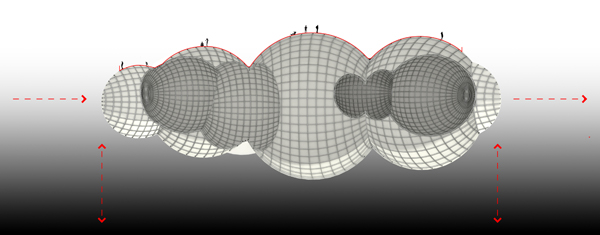
The Passing Cloud is an innovative and environmentally friendly method of transportation that doesn’t require expensive steel tracks or concrete highways. It is made of a series of spherical balloons that form the shape of a cloud. 


Its inner stainless steel structure is covered with heavy weight tensile nylon fabric. During the journey, It moves according to prevailing winds speed and direction at the time of travel. Since it moves with the wind, no wind is ever felt during the trip, offering the passengers a full “floating sensation”. 


It’s an unique journey. The feeling of floating in the atmosphere - on top of a cloud - with an open schedule and unknown final destiny. All National Ground would be potentially covered at virtually no cost and the help of the wind. The journey becomes your destiny.


Passing Cloud is a recently submitted project for the international ideas competition : Life at the Speed of Rail, organised by the Van Alen Institute and partly funded by the Department of Cultural Affairs of New York City. 


Although it wasn’t one of the winning proposals, Passing Cloud reveals a strong conceptual approach that is worth noting : It is a new vision on traveling, based on the old Zeppelins.


Nowadays, traveling is achieved with this idea of having a fixed destination and an estimated time of arrival. Passing Cloud completely inverts this system. A floating device is introduced that travels around the entire USA territory according to current predominant winds. It has no fixed time of arrival or place for arrival. The journey becomes the essence. Imagine traveling at wind speeds in a totally sustainable object that leaves no Human trace behind.

Subscribe on our RSS feed for more. Drop us a line if you have futuristic ideas that fit on our Blog. Get featured and stay connected with us. Feel free to join also our discussions.

*by andreascy*

🦾 Stay Motivated

👩🏻‍🚀 Artemis II Crew: From Friends to Family

▶️ Just Press Play

We all have days like this

[image or embed]

— Chris Paxton (@cpaxton.bsky.social) April 17, 2026 at 1:51 PM

⭐ Leading ShipYard's Leaderboard

🚩 Milestone Unlocked!

🏅 Win-Win