7 Reasons to Consider a Home Gym

If you think of picking up better health habits and don't like crowded gyms, consider setting a home gym catered to your needs.

5 Top Picks for Christmas Holiday Like a Fairytale

If you imagine Christmas holiday this year being like a fairytale, you should consider visiting these hidden gems!

7 Fashion Accessories To Lift Up Your Style Quotient

Get heads up on the trendiest as well as classic fashion accessories that would elevate your style to another level.

Sensibo

Showing posts with label MCUS and DSCs. Show all posts

Go Wireless with Renesas WiFi Out-of-the-Box Solutions


Description : 

Renesas Electronics the world's number one supplier of flash microcontrollers and advanced semiconductor solutions, presents RL78/G14 RDK kit. This kit features an integrated Wi-Fi utilities to provide a simple yet powerful mean to configure the WI-FI settings of this demonstration kit, define point to point Wi-Fi connections, run in a web server mode and connected to external clouds. 


Three presenters from Renesas Electronics Americas and from Gainspan Corp. are taking turn to introduce the feature of this new kit and all live sensor data feed can be transmitted over Wi-Fi. Alternately, it is shown how to :

  • Connect to the embedded Web Server and read sensor data
  • How to launch and run smartphone applications (iPhone or iPad or Android phones) and do the same thing.
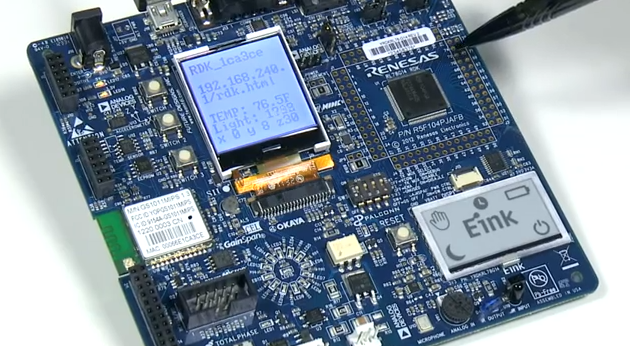

Renesas low power RL78/G14 demo kit gives customers exciting off-the-shelf building blocks to quickly prototype and create their own Wi-Fi cloud-connected M2M products. Customers can evaluation Wi-Fi connectivity and multiple connection modes with this low-cost demonstration kit.


For more information and to purchase a kit go here. Discover other Electronic related stories and  stay updated by subscribing to our News feeds. Comment below or send us your suggestions for the future.

*by andreascy*

Atmel SAM4L Microcontrollers : Redefining Low Power


Description : 

How much better would your designs be if power consumption was no longer a concern? Find out today with the SAM4L family of ARM® Cortex™-M4 processor-based microcontrollers (MCUs), which consume just one-third the power of currently available solutions. 


SAM4L MCUs redefine the power benchmark, delivering the lowest power in both active (90µA/MHz) and sleep modes (1.5µA with full random access memory (RAM) retention and 700nA in back-up mode). 


They are the most efficient MCUs available today, achieving up to 28 CoreMark™/mA using the IAR Embedded Workbench, version 6.40. In SAM4L MCUs, you also get the industry's shortest wake-up time at 1.5µs from deep-sleep mode. Just what you need for portable and battery-powered consumer, industrial and medical applications.

Bringing Atmel picoPower Technology to the ARM Platform :

The SAM4L family integrates Atmel's proprietary picoPower® technology, which is used in hundreds of millions of Atmel® AVR® MCUs in the market today. This patented picoPower ultra-low power technology ensures that devices are developed from the ground up - from transistor design to clocking options - to consume as little power as possible.


Fast wakeup and innovative power-saving features such as multiple regulators reduce the overall consumption even further. In addition, Atmel's SleepWalking technology allows the peripherals to make intelligent decisions and wake up the system upon qualifying events at the peripheral level. It's all about system intelligence and conserving energy. Simply put, the SAM4L MCU is your choice if you're looking for long battery life, without sacrificing performance.


Read the SAM4L Datasheet and check also other interesting topics from Atmel.

*by andreascy*

Microchip Technology : Get ready to see a new world of 8-bit PIC MCUs


Description : 

PIC microcontrollers are finding their way into new applications like Smartphones, Audio Accessories, Video Gaming Peripherals and Advanced Medical Devices. 


Microchip provides solutions for the entire performance range of 8-bit microcontrollers, with easy-to-use development tools, complete technical documentation and post design-in support through a global sales and distribution network.


PIC16F1512/13 MCUs (28-Pin Flash Microcontrollers with XLP Technology) combine eXtreme low-power technology and high digital & analog peripheral integration for use in a wide variety of applications. Check the short presentation below by Primo Castro (Product Marketing Manager at Microchip) and learn about the details on this Data Sheet. 


If you like this article you can discover more about MCUs and DSCs and Microchip Technology.

*by andreascy*

Microchip Technology : Spizzle Motion Sensing Software Demo

Description :

Microchip’s Motion Sensor Demo Board (Part #DM240316) is powered by a PIC24F microcontroller with on-board USB functionality and includes an MRF24J40MA 2.4GHz wireless transceiver that sends data wirelessly to a ZENA wireless adapter. 

Stephen Allen Applications Engineer at Microchip Technology

The board integrates an MPU-6050 motion sensing chip from InvenSense. The MPU-6050 has a 3-axis gyroscope, 3-axis accelerometer and uses sensor fusion technology to create a 3-D reference frame. 

Microchip’s Motion Sensor Demo Board allows you to easily add this breakthrough technology to your next gaming accessory, tablet PC, digital camera, robotic component, or any other consumer application. 

Spizzle Demo

The Spizzle Demo is actually a PC gaming application where you rotate a spherical puzzle and try to line it up for the approaching/matching pieces.


Learn more at Microchip's Quick Start Guide.

Check also similar Microchip's topics here. Do not miss also our Tech News and Newspaper for today as well as our Trending Tweets and our Magazine. Subscribe on our RSS for future updates. 

*by andreascy*

Microchip Technology MCP3911 (High Accuracy Energy Measurement)


Description :

The MCP3911 is a 2.7V to 3.6V dual channel Analog Front End (AFE) containing two synchronous sampling Delta-Sigma Analog-to-Digital Converters (ADC), two PGAs, phase delay compensation block, internal voltage reference, modulator output block, and highspeed 20 MHz SPI compatible serial interface. 


The MCP3911 is capable of interfacing a large variety of voltage and current sensors including shunts, current transformers, Rogowski coils and Hall effect sensors.


The video below presents a brief introduction to the MCP3911 Analog Front-End and reviews the MCP3911 ADC Evaluation Board for 16-bit MCUs for high accuracy energy measurement and data acquisition applications.


Learn more at Microchip. Please share this article with your social circles and show your support. If you want to get future updates to your email inbox or feed reader then kindly subscribe on our RSS feed and Newsletter. Do not miss also our trending news and tweets for today!

*by andreascy*

A Common Cause of Failure to Connect Atmel Studio 6 to Hardware

Description :

Atmel® Studio 6 is the integrated development environment (IDE) for developing and debugging Atmel ARM® Cortex™-M and Atmel AVR® microcontroller (MCU) based applications. 


The Atmel Studio 6 IDE gives you a seamless and easy-to-use environment to write, build and debug your applications written in C/C++ or assembly code. 


Today we are going to look at some of the causes of common communication failure between Atmel Studio 6 and some of the Atmel development tools. 

Demonstrated on a JTAGICE 3 and the XMEGA-A3BU.


Read also :

Atmel XSence Touch Sensors : Super Flexible screens

*by andreascy*

Bringing 100Mbps Ethernet to the Future Car

Description : 

With the ever increasing amount of electronics in vehicles, and the demanding nature of high-end and emerging applications, there is a great need for high-speed communications protocols. 

Bringing 100Mbps Ethernet to the Future Car

Emerging as front-runners for more wide-spread use are: 

- FlexRay 

- MOST 

- Ethernet

The Strategy Analytics Automotive Electronics Service (AES) report, "Automotive High Speed Networks," predicts that Ethernet will see both the fastest growth and the largest volume by 2020. The key breakthrough has been the BroadR-Reach physical layer, from Broadcom, now licensed to other semiconductor vendors, such as NXP. This allows Ethernet at 100 Mbit/s to be transmitted over low-cost, unshielded twisted pair cables.

“Ethernet has gained significant momentum because it meets the requirement for higher-bandwidth bus networks which many feel cannot be met by existing protocols, such as CAN,” stated Ian Riches, Director, Global Automotive Practice.

“FlexRay will continue to find its niche and see volumes grow, but MOST node volumes are likely to start to tail off as we head toward 2020,” added Mark Fitzgerald, Associate Director in the Strategy Analytics Global Automotive Practice.

Bringing 100Mbps Ethernet to the Future Car
100 Mbps symmetrical operation using standard Ethernet PHY components (Fig 1)

The OPEN Alliance (One-Pair Ether-Net) Special Interest Group has released their standard for in-vehicle Ethernet over a single twisted pair (Fig. 1). The OPEN Alliance includes two automotive companies, BMW and Hyundai USA, plus three semiconductor companies including Broadcom, Freescale and NXP. BMW will have the first vehicle based on BroadR-Reach technology in 2013.

OPEN fills a gap between CAN, Local Interconnect Network (LIN) and FlexRay that are using automotive control and Media Oriented Systems Transport (MOST), a high-end multimedia network. MOST uses fiber optics and runs at speeds up to 150 Mbits/s. It is a standard 10/100 Mbits/s Ethernet but it uses only a single, unshielded twisted pair cable comparable to that already used by FlexRay. Better yet, it is possible to deliver power over the same two wires like Power-over-Ethernet (POE). 

Bringing 100Mbps Ethernet to the Future Car
Twister pair Ethernet (Fig 2)

This is definitely a game changing approach because it is suitable for a range of applications throughout the car (Fig. 2) from On-Board Diagnostics (OBD) to Advanced Driver Assistance (ADAS) applications (Fig. 3).

Bringing 100Mbps Ethernet to the Future Car
Lower cost of digital camera deployment for advanced driver assist (Fig 3)

The standard defines new PHYs that connect to standard Ethernet MACs. This means that existing microcontrollers with an Ethernet Media Access Controller (MAC) with a Media Independent Interface (MII) can be mated to an OPEN PHY. There are no special drivers or protocols to incorporate. The system works equally well with any standard Ethernet device including those using protocols like IEEE 1588 clock synchronization. 

The standard supports the standard Ethernet audio/video bridging (AVB), 802.1BA. It also address temperature and EMC details that are critical to automotive applications. OPEN will be suitable for use anywhere on the car from the engine compartment to doors. Hardware can be qualified for Automotive Electronics Council (AEC) AEC-Q100. 

Cable length is limited to 47m. A typical automobile would need no more than a 30m limit but this allows the technology to be used in larger vehicles. The technology can work with significantly longer cables up to about 500m.

Bringing 100Mbps Ethernet to the Future Car
Automotive Networking and Consumer Connectivity Applications (Fig 4)

OPEN Ethernet mirrors standard Ethernet that is essentially a switch-based interconnect. This is key because bandwidth is less of an issue assuming a single application can be handled by a link. It is even possible to combine multiple links to provide higher bandwidth but this would be less likely given the drive to use a single cable to reduce costs.

In theory, the new Ethernet approach can reduce connectivity costs by up to 80% and reduces cabling weight by up to 30% compared to a conventional Ethernet LVDS interconnect. OPEN Ethernet can use connectors like those approved for FlexRay. This is important because, at least initially, automotive vendors are likely to use their own approved connectors and cabling.

Still, standard cables and connectors could be useful. For example, a four camera ADAS application would be less expensive if the cameras were a standard component. There is already a standardization effort for automotive cameras. All it would need to incorporate would be a standard OPEN connector. But that is for the future.

Right now the semiconductor participants are delivering chips to handle the new standard. Broadcom's BroadR-Reach family includes a set of PHYs and switches. There are three switches with a mix of built-in PHYs. These include the 7 port BCM89500 with 4 OPEN PHYs, the 7 port BCM89501 with 5 PHYs, and the 4 port BCM89200 with 2 PHYs. The ports without PHYs can be connected to devices or external PHYs. The BCM89810 is a standalone BroadR-Reach 10/100 PHY. This is the PHY that would be used with microcontrollers. In the future, this kind of PHY might be incorporated directly into a microcontroller.

Bringing 100Mbps Ethernet to the Future Car
OBD data can be emissions-based or nonemissions-based (Fig 5)

Also part of the mix is Broadcom's BCM89610 10/100/1000 PHY. This is a conventional Ethernet PHY optimized for automotive use. A single BCM89610 could provide a link to an external diagnostic system. The chip has the same EMC resistance as the other BroadR-Reach.

The OPEN Alliance and its members are targeting automotive applications but the technology is ideal for a host of other application areas from robotics to home security systems. Ethernet is already in demand in these applications and a two-wire solution with power easily beats existing technology in cost.

Ethernet has had a long and fruitful life becoming the dominant interconnect for a very wide range of applications. It could now become the dominant interconnect for automotive applications as well.

Check also "Ethernet for Automotive Applications"  by Dr Robert Bruckmeier (General Manager Central Control Units, BMW Group), Freescale Technology Forum.

READ ALSO: Metro Ethernet - Its Uses And Benefits

Got something to say? Post it below. Have an uber-super-awesomelicious week ahead! 😃💛

*by andreascy*

Microchip presents World's lowest current 16-bit MCU PIC24F GA3 Series


Description : 

As more electronic applications require low power or battery power, energy conservation becomes paramount. 


Today’s applications must consume little power, and in extreme cases, last for up to 15-20 years, while running from a single battery. 


To enable applications like these, products with Microchip’s nanoWatt XLP Technology offer the industry’s lowest currents for Run and Sleep, where extreme low power applications spend 90%-99% of their time. 


Discover more on this page. 

*by andreascy* 

TED : Massimo Banzi talks about how Arduino is an Open-Sourcing Imagination

Description :

Massimo Banzi helped invent the Arduino, a tiny, easy-to-use open-source microcontroller that's inspired thousands of people around the world to make the coolest things they can imagine -- from toys to satellite gear.


Because, as he says, "You don't need anyone's permission to make something great." 


*by andreascy*

Microchip's Microstick II for PIC32MX1 & MX2 Microcontrollers


Description :

The Microstick kits each deliver a complete development hardware platform for select Microchip 16-bit and 32-bit microcontrollers (MCUs) and digital signal controllers (DSCs). 


It’s the perfect solution to those looking for a low-cost, easy-to-use development platform.


All Microstick kits are USB-powered and include an on-board debugger/programmer, a Device Under Test (DUT socket) for easy device swapping, a user LED and reset button. 


These kits are designed for insertion into a standard prototyping board for easy connection to additional circuitry. 


The kits are extremely portable as well and is still about the size of a stick of gum!

Key Features :

- Low Cost

- Integrated USB programmer / debugger - No external debugger required

- USB Powered - Ease of use, No external power required

- MPLAB support.

- DUT Socket - Flexible, Easy device replacement

- 0.025” Pin headers - Enables plug-in to Breadboard with room for jumper wires

- Easy access to all device signals for probing

- Small size - Smaller than a stick of gum at 20 x76mm (approx) - Easily Portable

- On board User LED and Reset Switch

- Free demo code

Check out the video!


More on : 


Subscribe on our Newsletters for future updates to your email inbox or feeds reader. Share our article and help us to spread our voice. Feel free to comment below what you think.

*by andreascy*

Microchip's Graphical Display Solutions


Description :

Howdy folks? Today we share with you an easy and cost-effective graphics solution from Microchip Technology. 


Microchip's 16-bit, PIC24 MCUs and dsPIC® Digital Signal Controllers provide designers with an easy upgrade path from 8-bit PIC® microcontrollers and a cost effective option to 32-bit MCUs. 

Graphics Library

The broad product line includes everything from eXtreme Low Power microcontrollers to high performance digital signal controllers. 


Combined with hardware and free software these 16-bit products make the design of mTouch™ Sensing, Graphics, Connectivity, Digital Power Conversion, Smart Energy and Motor Control solutions easy to implement. 


Microchip keep getting better and better. 

I've been looking for an application like this for my car display. I'd love to replace my rocker switch panel with a touch screen display. What about you?

*by andreascy* 

dsPIC® DSC Digital Power Solutions


Description :

dsPIC digital signal controller digitally controls different power supply topologies. 


On display at Microchip's Design West booth were several of Microchip's digital power reference designs, including the solar micro inverter, LLC resonant converter, quarter brick DC/DC and LED development board. 


More on the video below :


You liked our post? Then kindly share it with your friends and show your support. Subscribe on our RSS feed and stay tuned for more!

*by andreascy*

Renesas announced the RL78 Green Energy Challenge!‏

Description : 

Renesas Electronics America, Inc. is leading a great green revolution and are challenging you to transform how the world experiences green energy and low-power design. Announcing the RL78 Green Energy Challenge!

Engineers from around the world will compete for top honor by developing a unique, low-power application featuring the RL78 microcontroller (MCU). Succeed and you'll win a share of a $17,500 Grand Prize! The competition starts on March 26, 2012 and ends August 30, 2012. Winners will be announced at the Renesas DevCon in October in Anaheim, CA. 


Follow Renesas on Twitter and Facebook for a chance to win additional weekly prizes from official contest partners! Pmods, development tools, and even more cash prizes are up for grabs. Follow the weekly challenge questions and answer correctly for your chance to win. 


Hundreds of free RL78/G13 Demonstration Kits ("RDK"s) are being distributed to those who qualify. 


The RDK is optimized for low power and features a great mix of peripherals. It is based on the 78K0R CPU core and can be applied to a variety of consumer and industrial applications. Optimized for low-power operation, this development kit runs with a 16-bit, 32-Mhz RL78G13 MCU @ 40.6 DMIPS. 


Software is supported by the IAR RL78 Embedded Workbench, as well as a Micrium full uC/Probe license. The RDK comes fully loaded with the Embedded Workbench, 16-KB Kickstart edition. Request a full license of the IAR Embedded Workbench when you sign up for a free RDK.
. 
Join the RL78 Green Energy Challenge today! 


More on Facebook :


Good luck!

*by andreascy*

🦾 Stay Motivated

🚀 Tesla Roadster Flies

▶️ Just Press Play

⭐ Leading ShipYard's Leaderboard

🚩 Milestone Unlocked!

🏅 Win-Win