7 Reasons to Consider a Home Gym

If you think of picking up better health habits and don't like crowded gyms, consider setting a home gym catered to your needs.

5 Top Picks for Christmas Holiday Like a Fairytale

If you imagine Christmas holiday this year being like a fairytale, you should consider visiting these hidden gems!

7 Fashion Accessories To Lift Up Your Style Quotient

Get heads up on the trendiest as well as classic fashion accessories that would elevate your style to another level.

Sensibo

Showing posts with label Printers. Show all posts

The 2 Food 3D Printers you Absolutely Need in your Kitchen

Description :

Have you ever watched an episode of Star Trek: The Next Generation where they used a Replicator to make something out of thin air? Have you ever thought it would be cool to have that technology, but never thought that it would be achieved in your lifetime? 3D printers have made this a possibility and bridged the gap between reality and science fiction. There’s even a few build it yourself and DIY printers that are on the market as well. 

Transforming the Food Industry

In terms of Food 3D Printers for consumers, there are plenty of options available. Right now the technology isn’t as advanced as what was shown on Star Trek, but this is just the early stages. 

The Food 3D Printers you Absolutely Need in your Kitchen

 There’s even been talk of bioprinting as an available option; this is the ability to print organic foods like a pear or an apple. The printer “ink” consists of 3 main components found in all foods: carbohydrates, fats and proteins. The raw ingredients are loaded into the printer, along with the appropriate ratios of food components; hit print and away you go. There have even been successful attempts at printing meat. The texture isn’t quite there yet but the taste is supposedly spot on. 

The two main hurdles faced by companies at the moment, is the texture/consistency of the food, and cooking the food while it’s being printed. If it’s a hamburger you’re looking for, yes you can have one printed. Just don’t be too surprised when the end result doesn’t look exactly like the burgers you’re used to.

The Food 3D Printers you Absolutely Need in your Kitchen

The taste of the food seems to be the easiest to recreate. As long as you know the correct ingredients, your food should taste the same as regular food. The only obvious difference is how the food is put together.

RELATED: Forget plastic - Bocusini 3D printer makes it possible to print fudge, jelly, and more 

Another reason that home and commercial 3D printers are having a hard time gaining popularity is due to the cost. Ironically it’s the industrial 3D printers that wind up being cheaper and this is because industrial machines are usually made with the purpose of printing only one part. Commercial machines have to be way more versatile; with more customization comes a larger price tag. It is still proving to be a challenge to fit the technology into a desk sized unit. Until companies can streamline and simplify the production, the cost is going to remain high. Creative Machines Lab is still developing printable muscle tissue. This will make it possible to reproduce more “real life” textures when printing foods like meat or fish. Don’t worry though, with the everyday advances in technology a cheaper and better performing printer will be on the market in no time.

Food 3D Printing is an extremely new concept with a range of potential benefits. Let's bring to the kitchen 2 very cool tools:

1. Foodini

 Foodini is made by a company called Natural Machines and prints mainly appetizers and entrees (burgers, pies, cookies and more). If you hate cooking, Foodini will save you some time.

The Food 3D Printers you Absolutely Need in your Kitchen

Here is a brief intro. Check out the beta and pre-production model in action:


2. ChefJet 

ChefJet is the other Food 3D Printer on the market made by a company called 3D Systems and its focus is mainly desserts (cakes, candies, just to name a few). However, it needs to be more developed.

The Food 3D Printers you Absolutely Need in your Kitchen

See it at work:


 Both are still being tested and perfected, and both are on the pricey side. The Foodini will set you back about $1,400 and the ChefJet can $5,000-$10,000, depending on if you want the single or multi-color machine. As of right now the Foodini is the only over-the-counter option. ChefJet has more testing to complete before they can offer a consumer-ready version of their machine.

Conclusion

Companies are not entirely sure how the general public will react to the idea of this new technology. People are scared of change. The same thing happened when the microwave first came out. At first everyone thought that it poisoned the food. Fast forward to today, and it is nearly impossible to find a house without one.

The Food 3D Printers you Absolutely Need in your Kitchen

Natural Machines is the first to point out that they are not on a quest to take all the work out of cooking. Instead they want to eliminate the time-consuming preparation that discourages people from wanting to cook in the first place. They also argue that the machines promote healthier eating because they require fresh ingredients to be prepared before the printing.

Despite the reason, this technology puts the human race one step closer towards the Jetsons and we as people need to ask ourselves; should we be doing this? The smartphone was supposed to revolutionize the way we communicate but ironically it’s made us more anti social. Will 3D food printers make us want to cook more, or simply be another unnecessary convenience? Like it or not the future is at our doorstep and only time will tell what this new technology has in store for us.


I'm just a guy, standing in front of the world, asking you to follow me. Any one on Twitter? Follow me @_andreascy. Thanks!

*by andreascy*

Common Printer Paper Buying Mistakes To Avoid

Description :

These days, you can find printers that come in different sizes. In addition to that, different types of printers come with different features in order to accommodate the varying needs that the user may have at home. Because of this, you must know what type of printing paper would work well with your printer. Your choice of printing paper will be as important as choosing the right ink and software.

Common Printer Paper Buying Mistakes To Avoid

For the usual documents, a generic printing paper will do. However, printing some important documents will require the use of the right type of printing paper. Here are some of the mistakes that people do when buying the printing paper:

Ignoring the Printer's manual

Printer manufacturers go through all the trouble on writing and printing the printer manual for a good reason. However, lots of people tend to ignore it when they use their printer. They would prefer using the trial and error method than actually making use of the tried and tested method as stated in the manual. When you take a look at the printer manual, you will get to see that they have specified the type and size of paper that will be perfect for your printer. 

Wrong Printer Paper weight

Once again, you will be able to see the specified weight of printer paper in the manual if you read it. 

Wrong printer paper Color

The whiter the paper you will use, the better color will appear on it after printing. This is one thing that not all printer paper users tend to overlook. Printer paper comes in different colors. However, the whiter, the better. This is true when it comes to printing documents that is related to your business or office.

Wrong Paper Finish

The finish of the paper will play an important role in the outcome of your documents. If for example, you are printing a picture, the wrong choice of paper finish will lead to unsatisfactory appearance of the pictures.

Too Much Money For The Paper

Another one thing to keep in mind when choosing a paper to print on is the budget. If you wish to find the perfect paper, then you must be able to know where is the right place to buy it. The place where you will be buying the paper can greatly affect the price you pay for it. There are lots of places where you can buy printer paper -- office supply stores, retails stores, online suppliers and many more. Make sure to do price comparison before you buy one.

Conclusion

The right choice of printing paper will allow you to save time on money. A lot of problems can be solved or printed just by reading your printer manual. Take time to do so. Avoid all these mistakes and you will surely enjoy a hassle-free document printing experience.


Do you like this post? If so, sign up for our Newsletter. Help us spread it by sharing it with your friends and family on Facebook, Twitter, and all other social networking sites. 

Thank you! 💛😎

*by andreascy*


How To Shop Black Friday Like A Pro

Description :

Black Friday is a great day to get huge TVs, powerful laptops and an array of other products for incredibly low prices. 

How To Shop Black Friday Like A Pro

If you're new to Black Friday shopping, or if you just want to learn how the pros do it, then follow these tips. You'll be finding the best sales without breaking a sweat.

Be Focused

The first thing that you have to do is being focused. Most people who shop on Black Friday love the amazing sales, but they are just going to buy anything that's cheap. This approach makes it difficult to find the best stores with your favorite products. What do you really want to buy? For example, let's say that you want a new laptop. After figuring out what you want, you can then compare the different stores that offer good laptops to see which one has the best price. Researching the price shouldn't be hard. You can check flyers and inserts, the store's website or check online for the latest Black Friday deals. You should bring the flyer or insert with you to ensure that you get the right price.

Make a Plan

Most people don't just visit one store on Black Friday. If you want to do a lot of shopping, like early Christmas shopping, then you'll want to make a plan to ensure that you visit every store on your list. You should organize your list based on which products you want the most. If you want a laptop, then visit a store with computers before going anywhere else. This ensures that you get the things that you really want, and anything else is just a bonus.

Small Stores

The big brands always advertise Black Friday sales, which causes a lot of people to visit them. Best Buy, Target and other similar stores have lots of sales, but they also have long lines. Consider visiting smaller stores. Due to public demand, nearly every store will have deep discounts on this day. You can call the store or visit the website to see what sales will be offered.

Social Media

Social media will be your best friend on Black Friday. Many retailers will issue last-minute coupons to ensure the highest number of sales. You should follow any retailers that you plan to visit on Black Friday. This will ensure that you get these coupons if they are issued, and you might get updates about new discounts.

Join Forces

Do you have a friend, spouse or child that loves shopping just as much as you? Then join forces to make Black Friday that much easier. For example, you can run to the cheapest product while the other person gets a cart or rushes to find another cheap product that you both want.

Be Comfortable

If you're going to be out all day, then ditch that bulky winter jacket for something more comfortable. It's a much better idea to dress in layers so that you can just remove one or two things to get comfortable. Those bulky jackets will make you feel tired halfway through your shopping because you'll be sweaty and uncomfortable.

SEE ALSO: Four Interesting Graduation Present Ideas

I love to blog about mobile phones and shopping tips. I recommend buying a smartphone from AT&T on Black Friday to take advantage of the biggest holiday saving.

*by andreascy*

Top Tech Money Savers for Your Business

Description :

Running a business is expensive. That’s just the name of the game. Them's the breaks, as they say. You need to pay your employees. You need to pay your taxes. You need supplies and for your utilities to stay on. All of those things cost money. 

Top Tech Money Savers for Your Business

There is no rule, however, that says you have to pay full price for everything all the time. Here are some of the best ways you can save money on technology for your business and use technology to save your business money:

1. Print Smart

If you’re paying full price for your toner and ordering it directly from the printer manufacturer, stop it! That’s like taking your car to the dealership for an inspection. There are much better ways to get your toner needs taken care of, and this includes your toner cartridge, premium LaserJet options or repairs for your copy machine. Why pay full price and then some if you don’t have to?

2. Go Solar

Solar chargers are going to be the best thing that happened to your office and your business utility bill. Solar chargers (especially if you get the “expanded editions” AKA, bigger cells that can store more power) make it possible to charge everything from cell phones and PDAs to laptop computers without ever having to plug those things in to an A/C outlet. This cuts down on the amount of energy your company uses (which reduces your electric bill). 

They’re also portable so they can help your employees keep their devices charged no matter where they are. Plus, going green is good karma, and what business couldn't use good karma!

3. Tablets Rule, Desktops Drool

Switch to tablet computers instead of forcing your employees to use desktops. Microsoft has great deals for small business owners who want to furnish their employees with tablets (Apple has similar deals if the iPad is more your company’s style). A few years ago switching to tablets was a pipe dream. Now, though, thanks to accessories like keyboards, styluses, etc you can get your tablet to function just like your desktop (sometimes even better).

This also helps make your workplace more portable. Your employees won’t require as much space to do their jobs. You can donate the desktop computers to charity for an additional business write off. Everybody wins!

4. Independent Contractors

Independent contractors and freelancers offer you the ability to get top notch work done for a fraction of what you’d pay for a full time employee. Plus, thanks to web based tools for teleconferencing, desktop sharing, etc—people can work together no matter where they are physically located. The primary benefit of working with an independent contractor or freelancer is that you only have to pay for the number of hours spent actually working or the work that actually gets completed. You don’t have to pay for time spent sitting in the office surfing Google News or playing Candy Crush on Facebook.

Even better, independent contractors and freelancers manage their own taxes and finances so you’ll save time and effort on your payroll duties.

Conclusion

These are just some of the things you can do to save money for your business (while also embracing the latest technologies). What are some of the things you’ve done to help save money and keep your business up to “techno-date”?

READ ALSO: Tech for the Sales Team

You are free to leave your questions below. Thank you for your time!

*by andreascy*

Chemistry World : 3D Printing of a Soft Network


Description : 

3D Printing has the potential to revolutionize the way we make almost everything. Designers and engineers in the aerospace and automotive sectors have been using the process for decades to build prototypes. Many complex parts manufactured by 3D Printing are now present on aircraft, satellites, medical industry etc. etc.

3D Printing technology is advancing rapidly and its cost is falling dramatically. And this means something that was once restricted to a few elite industries is quickly becoming  more widely available and affordable. It's going to open up so many new possibilities for new businesses, new business models, start-up companies, new products and much more!

Now lets learn about a synthetic material capable of performing some of the functions of living cells : Oxford University scientists have used a specially modified 3D prototype printer to lay down a network of interconnected, electrically conductive droplets. 


This technology could find it's way into tissue engineering applications, helping to support cells that are being grown into healthy new organs - replace damaged human tissue or deliver drugs to specific locations.

"We aren't trying to make materials that faithfully resemble tissues, but rather structures that can carry out the functions of tissues," says Professor Hagan Bayley, who led the research reported in the journal Science.

3D Printing lets you build an object as complex as an organ, layer by layer or droplet by droplet, explains Cameron Ferris a research associate from the ARC Centre of Excellence for Electromaterials Science at the University of Wollongong.


Read the full story at Chemistry World.

Related topics : 3D Printing Technology - Make things by printing them : How it works

Science Nation - Printable Robots Designed to be Consumer friendly, Inexpensive

Hi-Tech & Custom Designed 3D Printed Prosthetics

The Tomorrow Project : Conversations about Synthetic Biology

The more you subscribe on our feed news the more people will be able to reach, and  hopefully, inspire. We also would like to ask you to please share our posts with your friends and help us get the word out through social media and word of mouth. Thanks again for visiting our website!

*by andreascy*

Science Nation - Printable Robots Designed to be Consumer-friendly, Inexpensive


Description : 

Hello guys. Today we'll present to you an interesting project funded by the National Science Foundation's (NSF) Expeditions in Computing Program. This project envisions a future in which 3-D robotic systems can be produced and designed using 2-D desktop technology fabrication methods. If this feat is achieved, it would be possible for the average person to design, customize and print a specialized robot in a matter of hours. 

Currently, it takes years and many resources to produce, program and design a functioning robot. This project would completely automate the process, from sketches on-demand, anywhere, and with the skill of a team of professional engineers, leading to potential transformations in advanced manufacturing. 


"This research revolutionizes the design and manufacturing of robots, with a profound potential impact on society," says Ralph Wachter, a program director in the NSF Directorate for Computer and Information Science and Engineering. "It would remove barriers to manufacturing robots, making it possible for average citizens to customize and manufacture their own robots to meet their needs. This opens the door to great possibilities."


"This research envisions a whole new way of thinking about the design and manufacturing of robots, and could have a profound impact on society," says MIT Professor Daniela Rus, project leader and director of the Computer Science and Artificial Intelligence Lab (CSAIL). "We believe that it has the potential to transform manufacturing and to democratize access to robots."


The Computer Science and Artificial Intelligence Laboratory, known as CSAIL, is the largest interdepartmental laboratory at MIT and one of the world's most important centers of computer science and information technology research. The lab has played a major role in the technology revolution of the past 50 years. Currently, CSAIL is focused on conducting groundbreaking research in artificial intelligence, computer systems, and the theory of computation, while also tackling pressing societal challenges such as education, health care, manufacturing and transportation.


"Our goal is to develop technology that enables anyone to manufacture their own customized robot. This is truly a game changer," adds engineering professor Vijay Kumar, who is leading the team from the University of Pennsylvania. "It could allow for the rapid design and manufacture of customized goods, and change the way we teach science and technology in high schools."

Check out the video!


Related articles: 

3D Printing Technology - Make things by printing them : How it works

High Tech & Custom Designed 3D Printed Prosthetics

You like this topic? Then kindly share it with your friends and show your support for our cause!

Do not miss some of the latest trending tech news and tweets and of course our Magazine and Newspaper that gets updated daily with Tech & Science News, Big Stories and other Exclusives around the world. Subscribe on our RSS feed for future updates to your inbox.

*by andreascy*

Hi-Tech & Custom Designed 3D Printed Prosthetics


Description : 

The technology has been radically transformed from its origins as a tool used by manufacturers and designers to build prototypes. We know that there are already 3D printed hips and knees in use in the medical field. Nowadays it is manufacturing with a mouse click instead of hammers, nails and, well, workers. 


Advocates of the technology say that by doing away with manual labor, 3D printing could revamp the economics of manufacturing and revive the industry as creativity and ingenuity replace labor costs as the main concern around a variety of goods.


It takes a story like this one to really bring home the idea of how this technology changes lives. Traditionally, amputees have been offered one-size-fits-all prosthetics - functional but not particularly attractive. Now technology is blurring the line between medical devices and sculpture.


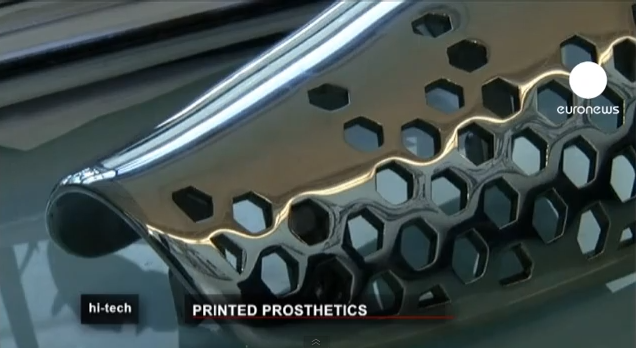
US designer Scott Summit is using a 3D printer to create a customised type of cover for a prosthetic leg.

He said: "I was always amazed it (the prosthetic) never looked like the sculpture I thought it should. They looked very utilitarian, like they came from engineers. They solved the mechanical function very well but they didn't really address the human part of the equation. And I thought that perhaps this is where design really wants to come in and change things, make things so that you see it first thing in the morning and you get excited because you can't wait to show it to the world."


The person's existing leg is scanned and the shape of the prosthetic cover is created. It can be customised with different materials - leather, chrome, heavy-duty plastic - some people even choose patterns, snakeskin or a tattoo.


Once the 3D computer scan is complete, the printing begins, building up very thin cross sectional slices until the final piece is complete. Much of the more aesthetic designs coming out of 3D Printers these days, are things that could not have been made by anyone just 10 years ago.


With 3D printers in the public sector the custom nature of products has gone further than ever before. The technology may eventually make these kinds of prosthetics more accessible. We love seeing this life-changing technology and i think there should be a Nobel prize for this!

*by andreascy*

Wireless Printing and Why You Need It

Description : 

Wireless printing is a technological innovation which is rapidly growing in popularity, and it's easy to see why. Wireless printing really gives conventional wired printing a bit of a 'slap in the face' as it allows you to print to your own printer or a printer of your choice from anywhere. Add to this the fact that you can print from a number of different tech-savvy devices such as laptops, tablets and even mobile phones, and you really have a very beneficial piece of kit at your disposal.

Wireless Printing and Why You Need It

Photograph of wireless printer by dennis and amiee jonez Via Flickr (CC BY-SA 2.0)
Unlike the back in the old days, where printing involved being connected to a wired network or even connected via a direct line from desktop to printer, today’s printers are far more functional. So, let’s have a look and see how this tech works and how its ease of use can have a positive impact on functionality and ultimately user experience.

Cloud Printing

'Cloud Printing' has become increasingly popular in recent times. You may have already glimpsed an insight into 'the Cloud' through other uses such as in backup and storage in particular. Cloud Printing allows users to connect over the web and use the printer in a way that is somewhat similar to a fax machine. To do this effectively you simply set up a designated printer on the Cloud via software hosted on your computer or phone, and then send what you need to be printed over the internet. One of the most amazing things about this technology is that you don’t need the device to be connected via a wireless network necessarily and you can actually use mobile connectivity to connect and print from your printer with ease.

There is one issue to note with some Cloud Printing apps and that is that not all software works on all manufacturers’ printers and so occasionally it can be quite troublesome trying to link up all sorts of applications, devices and printers, with the whole process being quite confusing. That said, software has improved since the early days of this technology, and continues to do so. Also over the years many third party companies have started to offer full suites of printing options, compatible with a vast range of printers, on just one piece of software.

Mobile Printing

One of the alternatives to Cloud Printing comes in the form of 'Mobile Printing'. Mobile Printing uses wireless technology, such as Bluetooth or Wi-Fi, to connect to the printer directly and send the documents which you require printing, whether these be standard page prints or images. Of course, unlike Cloud Printing, you can’t set up a print from the other side of the world with this form of data transfer as you will need to be within close proximity of your printer to print. That said, there are a number of ups however, and one of these is that as your data is not being sent over the internet it's actually a lot more secure than it would be if it were printed via Cloud Printing. Another thing with Mobile Printing is it can often be a lot faster, and you will not find yourself having to rely and count on the quality and speed of the internet connection in the area where you are.

Most printer manufacturers provide both Cloud and Mobile Printing solutions, and these days buying a printer with these capabilities will seldom cost a lot of money. In the case of both Cloud and Mobile Printing they can really be a benefit to your functionality by making it far easier to print at both work and home.

YOU MIGHT LIKE: The 2 Food 3D Printers you Absolutely Need in your Kitchen


*by andreascy*

Direct Differences Between Inkjet and Laser Printers

Description :

Torn Between an Inkjet and a Laser Printer? 

Can’t decide between an inkjet and a laser printer? You’re not alone. Most, if not all, consumers wanting to buy a new printer have faced this dilemma. 

Direct Differences Between Inkjet and Laser Printers

Often, budget constraints force a consumer to get the cheaper option, not knowing the better option to buy to meet their printing needs. Budget may play a big role in your choice of printer, but there are a variety of factors to consider, namely which one will work best for your projects.

Printing Volume 

One of the first things to consider when looking for a new printer is to know where you’re going to use it. Will it be used at home or at the office? Given this factor, a family, who occasionally uses a printer, will benefit most from an inkjet. On the other hand, you’ll most probably need a laser printer if you expect to print documents, photos, and other materials in high volumes. 

Size 

Another difference between inkjets and laser printers are their size. Generally, the latter tends to be larger in size. Hence, this is another reason homeowners, especially those with limited space, are best advised to purchase an inkjet printer. If space is not an issue, you can consider printers with laser technology. 

Speed 

Laser printers are best suited for those who expect high volumes of printing largely because of their print speed. Quality laser printers have faster printing capabilities and can print at a speed of 10-15 pages per minute - inkjet printers are not as fast and generally have a lower printing speed. Laser printers are then best for homes or businesses which require hundreds of pages printed at a time. 

Technology and Supplies 

Inkjet printers make use of simpler technology and parts compared to laser printers. As the name implies, ink is used for inkjet printers, while laser printers use toner. Unlike ink, toner is made, and needs to be used for, a specific kind of printer; meaning you can’t mix and match toner cartridges. 

Resolution 

Due to the difference in technology, the print quality and resolution vary between laser and inkjets. Laser technology in printers gives it a higher resolution and print quality and is best for printing in colour. Inkjets are better for printing word documents and the odd photograph. 

Paper 

To achieve the best resolution and printing outcomes, the right type of paper should also be considered. Remember, a laser printer works well with almost any kind of paper. On the other hand, inkjets work best with specialty paper designed for inkjet printers - otherwise, there’s a good chance you’ll end up with some fuzzy photos. 

Costs 

The laser printer might appear to cost more than an inkjet; however, you should always remember that your purchase should not be based on the initial costs alone. The cost of maintenance, if needed, ink, toner and paper should all be taken into consideration. 

Given the above list, the best thing to do when deciding what printer to buy, is first think about what you will mainly be using it for. That way, you won’t end up buying an inkjet when it’s a laser printer you should really be getting, and vice versa.

SEE ALSO:


Hope you enjoyed our story and your feedback is more than welcome! Last but not least, feel free to 'share' it with associates and loved ones! We' re also posting great tech content on this page, come take a look!

*by andreascy*

Print on the Go With The Free HP ePrint Mobile Printing App


Description :

Increasingly, work happens beyond the Office and outside of Business hours. And while employees are on the road or away from their desks, they need to print to stay productive - which means they need a convenient way to print on the go. 


HP ePrint is the essential app for printing from supported Smartphones to your HP printer. Whether at home, in the office or “on-the go”, easily print your digital content to your HP Printer via Wi-Fi or the Cloud. 


Also, easily print to thousands of HP ePrint Public Print Locations worldwide like airport lounges, hotels, print and copy stores, and libraries.

Public Print Locations include :

- FedEx Office stores

- The UPS Store locations

- Walmart Photo Centers (photos only)

- Many Hilton hotels (powered by PrinterOn)

- Many hotels, airline lounges, universities, public libraries and more (powered by PrinterOn)

With the free HP ePrint service app, it’s easy to discover a public location from your Smartphone. More than 90% of people using this app use the GPS capability to conveniently locate an HP ePrint Public Print Location nearby.


The app even includes a link to maps so you can get driving directions to the public print location if you are in an unfamiliar area.


To take advantage of thousands of HP ePrint Public Print Locations, download the free app by scanning the barcode below with your phone or clicking the appropriate link to download to your PC.


Note : Each HP ePrint Public Print Location has its own pricing policy. The availability of HP ePrint Public Print Locations varies.


If you liked this article feel free to comment below and let us know more about your experience with this app. Subscribe on our RSS feed for even more updates sent directly to your email. Do not miss also our trending news and tweets for today. Thanks for visiting our website!

*by andreascy*

Bad Ink : HP Anti-Counterfeit Program, Printing and Personal Systems

Description :

Counterfeit HP cartridges look like HP cartridges. Counterfeit HP cartridges feel like HP cartridges. Counterfeit HP cartridges are illegally sold to unsuspecting customers as HP, when in fact they aren't HP cartridges at all. 


However, the sad truth is that even the best counterfeit HP print cartridges cheat you out of your money and provide you with performance that can't compare to that of genuine HP cartridges. The quality and performance of a genuine HP print cartridge simply can't be reproduced.


Counterfeit print cartridges, by definition, are predominantly refilled or remanufactured print cartridges packed in unauthorized or fake reproductions of HP packaging. By illegally using the HP trademark, counterfeit products mislead consumers into believing they are getting genuine HP.


The video below shows how to recognize, report and prevent the manufacture and distribution of such counterfeit print cartridges.


For more information visit : 


*by andreascy*

3D Printing Technology - Make things by printing them: How it works

Description :

3D Printing is a technique that can create 3 dimensional objects by laying down multiple layers of material. The technology in itself is not that new, but costs have now dropped to a level where domestic 3D printing is a real possibility. 

3D Printing Technology - Make things by printing them: How it works

Recently the term is increasingly being used to describe all types of additive manufacturing processes, or even other types of rapid prototyping technology.

3D Printing Technology - Make things by printing them: How it works

Since 2003 there has been large growth in the sale of 3D printers. The technology also finds use in the fields of jewelry, footwear, industrial design, architecture, engineering and construction (AEC), automotive, aerospace, dental and medical industries, education, geographic information systems, civil engineering, and many others.

Methods and Technologies Used 

A large number of competing technologies are available to do 3D printing. Their main differences are found in the way layers are built to create parts. Some methods use melting or softening material to produce the layers, e.g. selective laser sintering (SLS) and fused deposition modeling (FDM), while others lay liquid materials that are cured with different technologies. In the case of laminated object manufacturing, thin layers are cut to shape and joined together. 

3D Printing Technology - Make things by printing them: How it works

Each method has its advantages and drawbacks, and consequently some companies offer a choice between powder and polymer as the material from which the object emerges. Generally, the main considerations are speed, cost of the printed prototype, cost of the 3D printer, choice and cost of materials and colour capabilities. 

3D Printing Technology - Make things by printing them: How it works

One method of 3D printing consists of an inkjet printing system. The printer creates the model one layer at a time by spreading a layer of powder (plaster, or resins) and inkjet printing a binder in the cross-section of the part. The process is repeated until every layer is printed. This technology is the only one that allows for the printing of full colour prototypes. This method also allows overhangs. 

3D Printing Technology - Make things by printing them: How it works

In digital light processing (DLP), a vat of liquid polymer is exposed to light from a DLP projector under safelight conditions. The exposed liquid polymer hardens. The build plate then moves down in small increments and the liquid polymer is again exposed to light. The process repeats until the model is built. The liquid polymer is then drained from the vat, leaving the solid model. The ZBuilder Ultra is an example of a DLP rapid prototyping system. 

3D Printing Technology - Make things by printing them: How it works

Fused deposition modeling, a technology developed by Stratasys that is used in traditional rapid prototyping, uses a nozzle to deposit molten polymer onto a support structure, layer by layer. 

3D Printing Technology - Make things by printing them: How it works

Another approach is selective fusing of print media in a granular bed. In this variation, the unfused media serves to support overhangs and thin walls in the part being produced, reducing the need for auxiliary temporary supports for the workpiece. Typically a laser is used to sinter the media and form the solid. Examples of this are selective laser sintering and direct metal laser sintering (DMLS) using metals. 

3D Printing Technology - Make things by printing them: How it works

Yet another approach uses a synthetic resin that is solidified using LEDs. 

Ultra-small features may be made by the 3D microfabrication technique of 2-photon photopolymerization. In this approach, the desired 3D object is traced out in a block of gel by a focused laser. The gel is cured to a solid only in the places where the laser was focused, because of the nonlinear nature of photoexcitation, and then the remaining gel is washed away. Feature sizes of under 100 nm are easily produced, as well as complex structures such as moving and interlocked parts. 

Unlike stereolithography, inkjet 3D printing is optimized for speed, low cost, and ease-of-use, making it suitable for visualizing during the conceptual stages of engineering design through to early-stage functional testing. No toxic chemicals like those used in stereolithography are required, and minimal post printing finish work is needed; one need only to use the printer itself to blow off surrounding powder after the printing process.

3D Printing Technology - Make things by printing them: How it works

Bonded powder prints can be further strengthened by wax or thermoset polymer impregnation. FDM parts can be strengthened by wicking another metal into the part. 

How 3D Printing Will Change Absolutely Everything It Touches 

The sudden buzz about 3D printing and its potential has triggered a deafening din in the media and elsewhere. Is all the hype realistic, especially since the ability to print objects made of plastics and various other materials has been around for about a decade? Will this prove a transformative technology? Will it revolutionize manufacturing or even medicine? 

The answers is Yes, Yes and Yes. 

Already, 3D printing has been refined to the point where digital models can be duplicated into physical prototypes or production parts that closely resemble mass-produced products in looks and function. And prices of 3D printers have declined substantially in the past five years, to as low as $1,000 from $400,000 five years ago. 

3D Printing Technology - Make things by printing them: How it works

As a result, myriad industries - from automotive (which already created the first 3D printed car) and aerospace to footwear and jewelry - have embraced 3D printing that creates objects by laying down successive layers of materials. The Wohlers Report, an annual in-depth study of the advances in additive manufacturing technologies and applications, estimates 3D printing will grow to become a $5.2 billion industry by 2020, up from $1.3 billion last year.

3D Printing Technology - Make things by printing them: How it works

Indeed, the digital age is providing companies of all sizes - as well as individuals - with the means to design and make a product relatively inexpensively. In turn, these tools are transforming the role of the traditional factory. Soon - really - it will be possible to print out products at home ranging from appliance parts to shoes. You will be able to have that dishwasher part made just for you instantly. This promises to empower a new wave of design and customization fueled by our personal taste and imagination. 

3D Printing Technology - Make things by printing them: How it works

Already, Nike with its Nike iD services lets customers personalize and design their own Nike merchandise, down to their favorite colors and materials. Amsterdam-based Freedom of Creation, renowned for its lighting designs, has 3D-printed fixtures gracing the interiors of luxury hotels around the world. Canada-based Weatherhaven, which supplies portable shelters, digitally explores and validates its custom designs without having to build physical prototypes. This saves the company up to $100,000 per shelter. As a result, yesterday’s factory is evolving into a global community of custom design and personal fabrication services. And manufacturers are creatively embracing the changes. 

3D Printing Technology - Make things by printing them: How it works

To be sure, the most revolutionary advances for 3D printing are probably a decade or more away. But as 3D printers continue to drop in price, much like color printer prices have fallen, it will not be long before the average tech-savvy household can afford a 3D printer. When that occurs, the dreams of inventors and entrepreneurs will be realized. They simply will build a 3D model of their breakthrough idea on their computer and click “print.” 

Furthermore, they likely will produce final products, not just prototypes; 20-25 percent of 3D “prints” are final products today, and analysts estimate that percentage will climb to 50 percent within the next decade. 

3D Printing Technology - Make things by printing them: How it works

Already, the boundaries of 3D technology are widening substantially with the 3D printed car, the two-seat Urbee created by KOR EcoLogic of Canada. All of its body parts were made using 3D printers, including its glass panels. Scientists in Bristol, England, printed a fully functional bicycle in March and three months later, they printed a bikini, showing how easy it is to print unique products with the same manufacturing process. 

3D Printing Technology - Make things by printing them: How it works

This explains why the medical profession foresees a time when more sophisticated 3D printing will produce replacement organs or drug therapies. There is little question that the evolution of this transformative technology promises to ignite a new era of custom manufacturing.

On the first video CNET's Rafe Needleman interviews the makers of two 3D printer makers and how they are charting the future of manufacturing. The next is a video from Christopher Barnatt of "ExplainingTheFuture.com" that illustrates 3D printing today and in the future.


Check out also :

The Pentagon is Investing Millions to Advance the Future of 3-D Printing Tech

If you like our article kindly share it with your friends and other social circles. Subscribe on our Newsletter for direct email updates. 

Trending News, Big Stories and other Exclusives are also available on our Facebook, Twitter, and on other sites.

Take care!

*by andreascy*

🦾 Stay Motivated

👩🏻‍🚀 Artemis II Crew: From Friends to Family

▶️ Just Press Play

We all have days like this

[image or embed]

— Chris Paxton (@cpaxton.bsky.social) April 17, 2026 at 1:51 PM

⭐ Leading ShipYard's Leaderboard

🚩 Milestone Unlocked!

🏅 Win-Win